
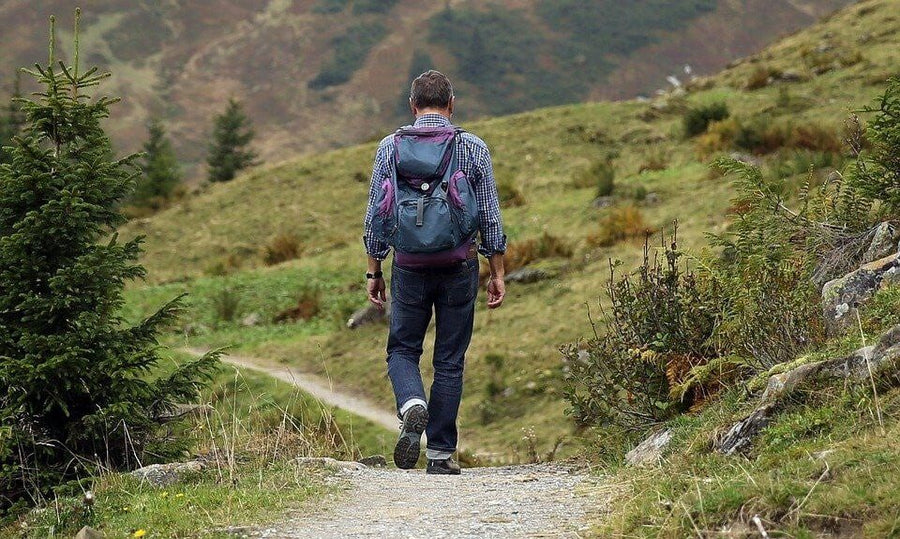
Why hiking is more beneficial than a walk in the park.
It’s a common axiom that being in nature and walking are beneficial for mental well-being. But what exactly are these benefits?
From this article you will learn:
- What is hiking and how does it differ from other types of hiking?
- Why do we feel so good in nature?
- How hiking clears your head and reduces technostress;
- What is the relationship between nature walks and cortisol levels ?
- Can hiking help cope with negative feelings?
- What you need to start hiking .
What is hiking?
The phrase “hiking” conjures up images of bearded Soviet engineers scaling mountains in snow and rain. But modern tourism culture also promotes more comfortable and safer forms of travel. For example, hiking is accessible to everyone, even those not accustomed to strenuous physical activity.
HikesHiking is walking a significant distance outdoors, often over natural terrain, with obstacles to overcome (such as rocks, tree roots, and small streams). Hiking can be done in mountains, forests, parks, and other natural areas. The route is typically 10–15 kilometers long.
Hiking isn’t the only type of hiking. There’s also trekking, a long journey along a challenging route. Trekking is typically done in the mountains, requiring endurance and strength. It’s more suitable for those who enjoy sports, fitness, or at least lead an active lifestyle.
Unlike trekking, hiking involves a maximum of one overnight stay along the route—in a tent or even at a hotel along the way. Therefore, you won’t need a heavy backpack with a multi-day supply of food. And it’s much easier to enjoy being at one with nature when traveling light.
Why do you feel so good in nature?
Is Researchers from the European Centre for Environment and Health note that social connections are crucial for well-being. They provide us with self-esteem and a sense of meaning. However, in a 2018 study, researchers found that people with low social connections but high levels of closeness to nature also report high levels of well-being. In other words, even lonely people feel happy and thriving when surrounded by nature [1].
The study’s authors suggest that contact with people and nature satisfies the same psychological need: belonging. This can also be described as “being part of something greater than the individual self.” Nature is full of living creatures—plants, insects, birds—and observing their lives gives us a sense of peace and inner calm.
How Hiking Clears Your Head
Hiking is said to help clear your head—literally increasing the flow of oxygen to the brain. This has a positive effect on our cognitive functions and mood.[2]. But it turns out that the influence of oxygen is not the main thing in this process!
During a long walk, the human brain switches to the so-called default mode network. While external stimuli are minimized, our brain is not idle (it is never idle), but is engaged in self-awareness: it recognizes and analyzes its emotions, controls the distinction between good and bad in social and moral understanding, and forms self-descriptions, as well as opinions about past and future events and its attitude toward them [3].
How Nature walks and cortisol levels are linked.
Choron Son, Harumi Ikei, and Miyazaki Yoshifumi from the Center for Environment, Health, and Nature Sciences at Chiba University (Japan) reviewed 52 articles that examined the physiological effects of “nature therapy”—that is, the health-promoting practice of spending time in nature. The scientists noted that during such walks, the subjects’ levels of cortisol, a hormone produced by the adrenal glands and associated with stress, decreased. Interestingly, cortisol levels in those who walked in the city were 15.8% higher than those in forested areas [4].
How Hiking Reduces Technostress
The term “technostress” was coined in 1984 by American psychologist Craig Broad. He defined it as stress experienced by a person due to ineffective work practices. communication with a computer. But after 20 years, this term has changed its meaning.
Today, occupational health and safety specialists define technostress as a feeling of overwhelm due to the constant use of digital devices and information overload. Symptoms of technostress include an inability to focus on a single problem, increased irritability, and a feeling of loss of control [5].
Spending time in nature is a digital detox, free from the influence of gadgets. During a walk or a stroll in nature, we can put down our ubiquitous smartphone and stop overloading our brains with information. Instead, we can leisurely observe the flow of life, while our brains relax.
MoCan hiking help cope with difficult negative feelings?
Yes. Austrian clinical psychologists Joseph Sturm and Martin Ploederl observed two groups of people who went on a supervised mountain hike. Each group included participants who complained of profound feelings of hopelessness and had made several suicide attempts. After completing the hike, the participants reported a decrease in feelings of hopelessness and suicidal ideation [6].
Other researchers, this time from Stanford, found that people who walk for 90 minutes in a park experience reduced activity in the prefrontal cortex, a region associated with rumination. Rumination is uncontrollably repetitive thoughts focused on negative aspects of oneself. During long walks through a park or nature reserve, the brain switches to default mode, reducing prefrontal cortex activity—and with it, the endless stream of self-deprecation that generates emotional pain [7].
Hiking is better for mental health than walking in the park.
Scientists studying the impact of nature on people most often conduct their experiments in urban green spaces (parks and squares). The reason is simple: they are easier for participants to get to. However, in the aforementioned study by the European Centre for Environment and Human Health, 4,500 participants reported feeling more rested after visiting natural areas such as nature reserves and rural areas (compared to urban green spaces like parks and squares).
How to start hiking
As you’ve probably already figured out, hiking is a lighter version of camping. No special preparation is required: just find a simple route, choose clothes, shoes, and pack to take a backpack.
Footwear deserves special attention: on a long hike, good sneakers or trekking boots will make you feel better. If you only have street shoes, you can go to a specialized sports store and ask a salesperson to help you choose a suitable pair. But do this well in advance, a couple of weeks before the hike, to allow time to break in the shoes. Hiking in new sneakers is dangerous: they can start to irritate your feet, ruining the experience.
You can plan your first outing in a group—searching for “hiking [your region] club” will likely yield several options for hiking groups and clubs. Hiking together is more enjoyable and safer. Speaking of safety: if you have any chronic illnesses, consult your doctor before hiking.